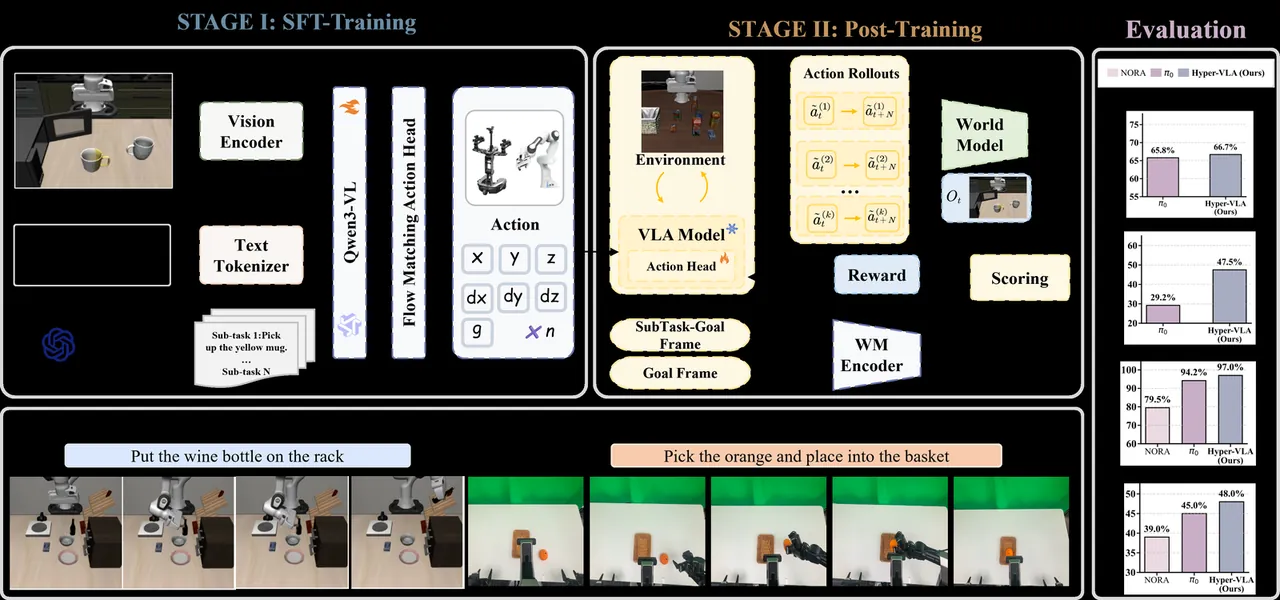
现有 VLA 只用粗粒度的 high-level instruction 做 SFT,中间过程缺少显式指引,长程任务里误差不断累积。AtomVLA 用 LLM(GPT-4o) 把每条示范拆成 fine-grained atomic subtasks 一起喂给策略,再用一个 predictive latent world model(V-JEPA2) 在隐空间里给候选 action chunk 打分,从而在完全离线、不跑真机 rollout 的前提下做 GRPO post-training。LIBERO 平均成功率 97.0%,LIBERO-PRO 48.0%,真机泛化设定下比 π0 高 18.3%。
论文把当前 VLA 从"实验室示范"走向"长程稳定部署"的障碍归纳为三点:预训练成本高、语义-视觉信息不对称(instruction grounding gap)、以及真机在线 RL 代价过高。
"This instruction grounding gap leaves models without explicit intermediate guidance, leading to severe compounding errors in long-horizon tasks."
作者指出,高维 visual token 往往主导 latent space,导致 "the learned policy struggles to ground sparse linguistic instructions into sequential physical guidance";而 "the high costs and safety risks of real-world interaction make online reinforcement learning (RL) impractical for most robotic platforms, leaving a gap between static imitation learning and dynamic policy refinement."
已有的补救路线各有短板:LLaVA-VLA / SmolVLA / TinyVLA 走轻量化,CycleVLA 改进语义理解,RoboTwin 用仿真造数据——但它们大多仍依赖 imitation learning,且是 reactive action generation,缺少对真实动态演化的 latent 预测能力。另一条路是用 generative world model 当虚拟模拟器,可 "Standard generative world models typically synthesize future states at the pixel level. This mechanism inevitably leads to the accumulation of autoregressive errors and produces visual hallucinations during long sequence predictions."
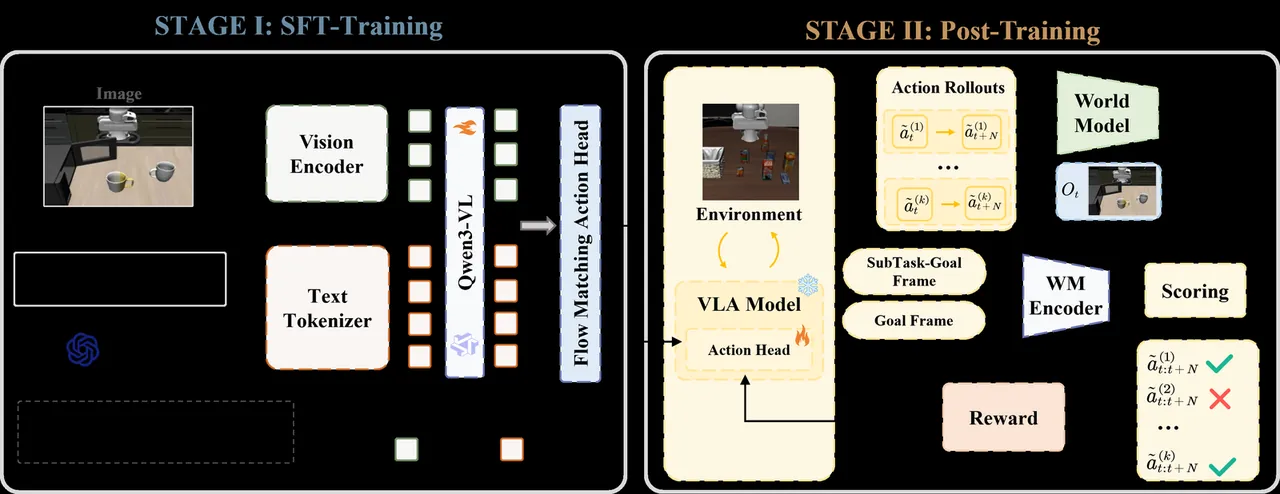
AtomVLA 是一个两阶段框架:Stage I 做 subtask-aware 的 SFT,Stage II 用 world-model reward 做离线 GRPO。论文称其为 "the first subtask-aware VLA framework integrated with a scalable offline post-training pipeline"。
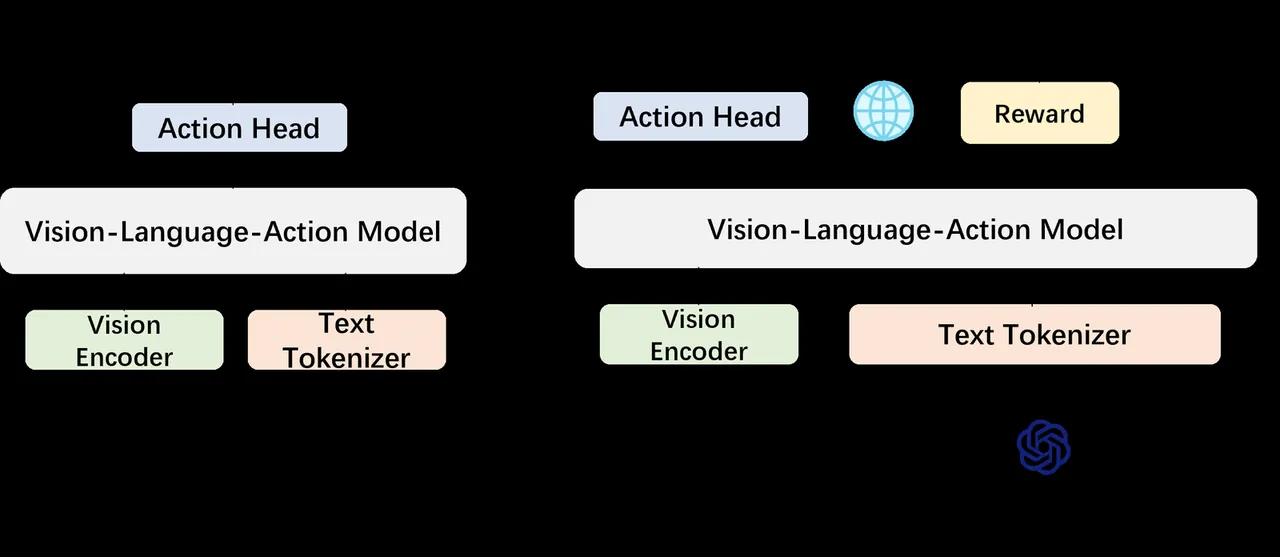
VLM backbone 用开源多模态 Qwen3-VL-4B-Instruct。时刻 t 给定多视角观测 Ot、高层指令 It 与子任务指令 SIt,backbone 编码为 Ht = fVLM(Ot, It + SIt),再通过 cross-attention 条件化 action expert。
Action head 是一个 cross-attention Diffusion Transformer,作为 flow-matching head 回归长度为 N 的 action chunk。训练时采样 ε∼N(0,I)、τ∈(0,1),构造 xτ = (1−τ)ε + τ·at:t+N,回归目标速度 v = at:t+N − ε,损失为 LFM。推理时从 a(0)∼N(0,I) 出发,用显式 Euler 更新迭代 K 步(Δt = 1/K)得到最终 action chunk。
给 LLM 一段采样帧序列与任务上下文,让它把整条示范切成若干 atomic subtask,返回 JSON 元组列表 {(ℓi, si, ei)}i=1..M——ℓi 是子任务指令,si/ei 是起止帧。为保证粒度一致,prompt 明确约束子任务对齐到一小组基本操作表达(如 Pick up [object]、Place [object] on [target position]、Open/Close [object]、Push [object]),而不是过细的中间过程描述。在这一规则下一个任务被拆成 2–5 个子任务。实现中用 GPT-4o 完成分解与标注。
采用 V-JEPA2 作为冻结的视觉编码器 J(·),把图像映射为 latent token 序列;再在其之上建一个 action-conditioned 的 predictor 网络 Wθ,把当前观测与候选 action chunk 滚动出隐空间未来:ẑt+N = Wθ(J(Ot), ãt:t+N)。关键点是全程在 latent space 比较,绕开 pixel-level 合成的 autoregressive 误差与 visual hallucination。
把每个子任务的边界帧当中间目标:令 b(t) 为当前子任务结束后的第一帧,取 Ob(t) 为 subgoal、同一 episode 的 OT−1 为最终目标,对每个候选算两个 goal energy(L1、越低越好):
最终标量 reward 为 r = −(λsubEsub + λgoalEgoal + α·D),其中 λsub = 0.3、λgoal = 0.4、α = 0.3。
每个状态生成 K 个候选,组内归一化 reward 得到 advantage A(k),提升高 advantage 候选的似然,并对冻结的 SFT reference policy πref 加 KL 惩罚保证稳定性。状态直接从 Stage I 用的同一份离线示范数据集采样,因此 "enables highly efficient Group Relative Policy Optimization without the prohibitive expenses associated with online rollouts on physical robots"。post-training 阶段只更新 action head / action expert 参数,以 "preserve stable vision-language representations while improving long-horizon robustness"。
仿真在 LIBERO(Spatial / Object / Goal / Long 四个 suite,每个 10 任务 × 500 条示范)与 LIBERO-PRO(加入受控扰动)上评测,指标为 success rate (SR),每个任务评测 50 次。SFT 在 LIBERO 上训练 2 epochs;post-training 采样 100K trajectories,每个样本 10 个候选。
| Method | w/o Pre-Training | Size | Spatial | Object | Goal | Long | Avg. |
|---|---|---|---|---|---|---|---|
| TraceVLA | ✗ | 7B | 84.6% | 85.2% | 75.1% | 54.1% | 74.8% |
| OpenVLA | ✓ | 7B | 84.7% | 88.4% | 79.2% | 53.7% | 76.5% |
| SpatialVLA | ✓ | 4B | 88.2% | 89.9% | 78.6% | 55.5% | 78.1% |
| CoT-VLA | ✓ | 7B | 87.5% | 91.6% | 87.6% | 69.0% | 83.9% |
| ThinkAct | ✗ | 7B | 88.3% | 91.4% | 87.1% | 70.9% | 84.4% |
| NORA | ✓ | 3B | 85.6% | 89.4% | 80.0% | 63.0% | 79.5% |
| π0 | ✓ | 4B | 96.8% | 98.8% | 95.8% | 85.2% | 94.2% |
| NORA-1.5 | ✓ | 3B | 97.3% | 96.4% | 94.5% | 89.6% | 94.5% |
| AtomVLA (SFT) | ✗ | 4B | 94.1% | 95.4% | 92.4% | 90.0% | 93.0% |
| AtomVLA (SFT + Post-Training) | ✗ | 4B | 96.4% | 99.6% | 97.6% | 94.4% | 97.0% |
| Δ from GRPO | — | — | 2.3%↑ | 4.2%↑ | 5.2%↑ | 4.4%↑ | 4.0%↑ |
Key Finding 1:"Cross-embodiment large-scale pre-training is not necessary to achieve strong downstream performance." —— 即便没有跨本体大规模预训练,仅 SFT 就达到 93% 平均成功率,说明只用 in-domain multi-task 示范足以学到稳健的 vision–language-to-action 映射。
Key Finding 2:post-training 在所有 LIBERO suite 上都优于 SFT baseline,其中 LIBERO-Goal 增益最大,作者归因于 group 级别的对比监督 + world model 评估强化了更满足中间 subgoal 与最终目标的轨迹。(原文正文写的是 "with the largest gain on LIBERO-Goal (+6.0%)",但 Table III 的 Δ 行给的是 5.2%↑,92.4% → 97.6% 也确为 +5.2%——论文自身存在这处不一致,此处按表格数值理解。)
每个 suite 分 Obj / Pos / Sem / Task 四个扰动维度,数值为 0–1 的成功率。
| Method | LIBERO-Goal | LIBERO-Spatial | LIBERO-10 | LIBERO-Object | Avg. | ||||||||||||
|---|---|---|---|---|---|---|---|---|---|---|---|---|---|---|---|---|---|
| Obj | Pos | Sem | Task | Obj | Pos | Sem | Task | Obj | Pos | Sem | Task | Obj | Pos | Sem | Task | ||
| π0 | 0.94 | 0.00 | 0.93 | 0.00 | 0.95 | 0.00 | 0.97 | 0.00 | 0.79 | 0.00 | 0.82 | 0.00 | 0.94 | 0.00 | 0.90 | 0.00 | 0.45 |
| MolmoAct | 0.68 | 0.00 | 0.85 | 0.00 | 0.90 | 0.00 | 0.88 | 0.00 | 0.54 | 0.00 | 0.74 | 0.06 | 0.92 | 0.06 | 0.96 | 0.00 | 0.41 |
| NORA | 0.58 | 0.00 | 0.88 | 0.00 | 0.92 | 0.00 | 0.91 | 0.00 | 0.46 | 0.00 | 0.74 | 0.00 | 0.86 | 0.00 | 0.92 | 0.00 | 0.39 |
| X-VLA | 0.68 | 0.01 | 0.98 | 0.09 | 0.97 | 0.00 | 0.96 | 0.00 | 0.62 | 0.00 | 0.95 | 0.10 | 0.89 | 0.02 | 0.98 | 0.08 | 0.46 |
| AtomVLA (Ours) | 0.81 | 0.02 | 0.98 | 0.11 | 0.95 | 0.16 | 0.95 | 0.01 | 0.55 | 0.01 | 0.95 | 0.09 | 0.93 | 0.10 | 0.99 | 0.00 | 0.48 |
| Input | LIBERO-Long |
|---|---|
| Image | 80.4% |
| Image + High-level Task | 90.0% |
| Image + High-level Task + Atomic Task | 92.2% |
去掉语言指令导致 LIBERO-Long 明显下降(−9.6%);加入高层任务指令到 90.0%,再补上子任务描述额外提升到 92.2%。论文解释:子任务指令为当前阶段提供了显式中间目标,同时保留整体任务目标,改善了长程任务的 credit assignment。
| Chunk Size | Spatial | Object | Goal | Long | Avg. |
|---|---|---|---|---|---|
| 4 | 96.4% | 99.6% | 97.6% | 94.4% | 97.0% |
| 8 | 95.6% | 99.2% | 98.4% | 93.0% | 96.6% |
| 16 | 96.0% | 99.8% | 98.8% | 91.6% | 96.6% |
| 32 | 96.0% | 99.0% | 98.8% | 91.2% | 96.3% |
chunk size = 4 平均最优。注意 Object (99.8%) 与 Goal (98.8%) 的单项最好值其实出现在 chunk 16/32 上,只是 Long 随 chunk 增大持续退化(94.4% → 91.2%),拉低了平均。论文解释:"An overly large chunk size reduces execution flexibility and exacerbates the accumulation of compounding errors."
| Reward | Spatial | Object | Goal | Long | Avg. |
|---|---|---|---|---|---|
| SFT | 94.1% | 95.4% | 92.4% | 90.0% | 93.0% |
| Esub + D | 96.3% | 98.0% | 96.2% | 93.5% | 96.0% |
| Egoal + D | 97.1% | 97.9% | 96.0% | 93.2% | 96.1% |
| Esub + Egoal + D | 96.4% | 99.6% | 97.6% | 94.4% | 97.0% |
两个 elementary reward 单独用都能超过 SFT 约 3.0%,组合后整体提升 4.0%,Long suite 上 +4.4%。作者认为二者协同:"the combined reward mitigates noise from purely long-horizon world model predictions while avoiding short-sighted biases induced by focusing solely on immediate subgoals." 有趣的是 Spatial 上单用 Egoal+D 的 97.1% 反而高于完整 reward 的 96.4%。
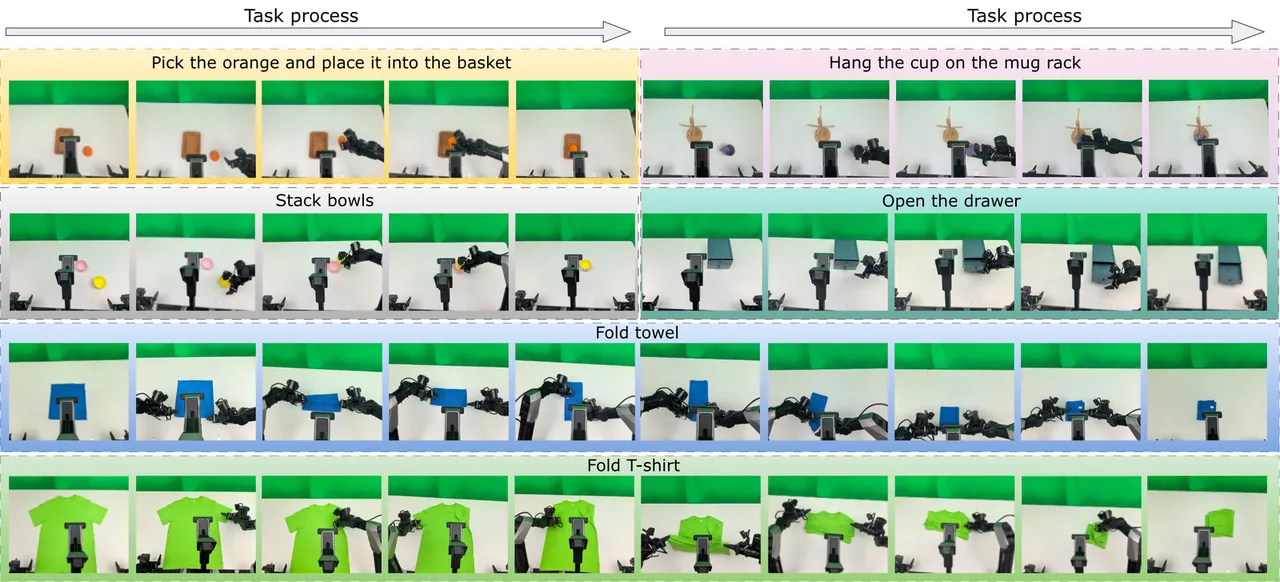
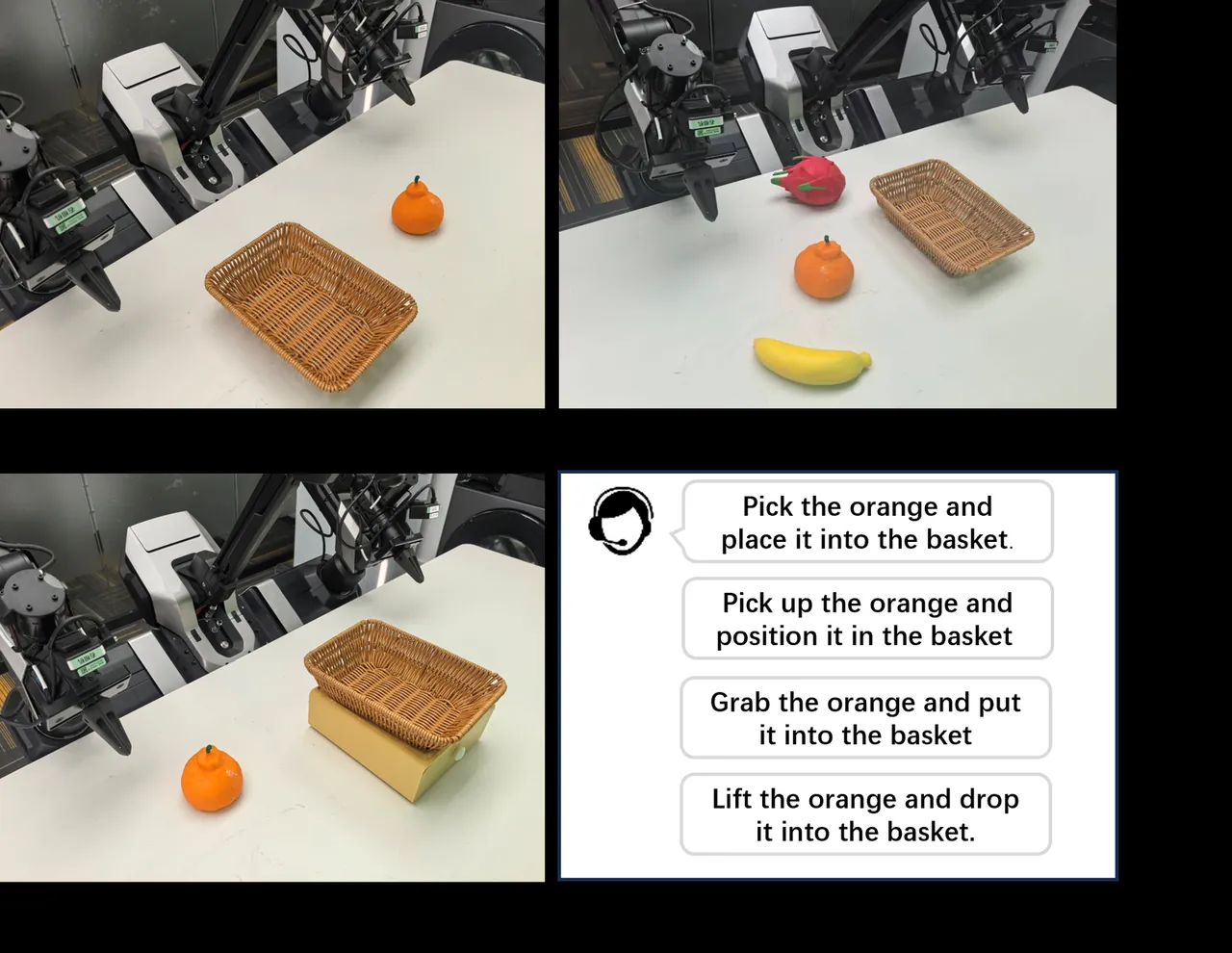
双臂移动平台(三全向轮、两条 6-DoF 臂、两个腕部相机 + 一个头部相机),实验中移动模块保持静止。任务分 Basic(stack bowls / put fruit into basket / hang cup / open drawer)与 Hard(fold T-shirt / fold towel,可形变物体 + 长程)。每任务 100 条示范,SFT 2 epochs 后 post-training(100K trajectories、每状态 10 候选),每任务评测 20 次。ST = Standard 设定;GE = Generalization 设定,引入物体位置随机、未见干扰物、目标高度变化、指令措辞变化四类扰动。
| Task | π0 | AtomVLA (Ours) | ||
|---|---|---|---|---|
| ST | GE | ST | GE | |
| Stack bowls | 95% | 60% | 90% | 80% |
| Put fruit into basket | 85% | 45% | 90% | 65% |
| Hang cup | 70% | 15% | 70% | 35% |
| Open drawer | 60% | 30% | 60% | 45% |
| Fold T-shirt | 35% | 5% | 40% | 25% |
| Fold towel | 50% | 20% | 50% | 35% |
| Average | 65.8% | 29.2% | 66.7% | 47.5% |
Key Finding 6:ST 设定下 AtomVLA 与 π0 基础能力相当(66.7% vs 65.8%,差距仅 0.9%,stack bowls 上 AtomVLA 90% 还低于 π0 的 95%);真正拉开差距的是 GE 设定——baseline 骤降到 29.2%,AtomVLA 保持 47.5%,绝对提升 18.3%。可形变物体的长程任务差距最明显:Fold T-shirt 25% vs 5%,Fold towel 35% vs 20%。
原文:"While our framework enables long-horizon tasks, adapting to highly dynamic environments remains challenging because the current system relies on static subtask boundaries generated by LLM." 作者提出的未来方向是 "end-to-end subtask generation during execution and world models that can perceive uncertainty"(执行期在线生成子任务 + 能感知不确定性的 world model)。
原文:"we intend to systematically enhance the generalization capabilities of our approach to handle entirely unseen objects and novel semantic instructions."
Table IV 中 AtomVLA 在 Pos 维度最好只有 0.16(Spatial),Task 维度最好 0.11(Goal),LIBERO-Object 的 Task 更是 0.00。平均 0.48 的领先主要来自 Obj 与 Sem 两个维度。也就是说"位置扰动"和"任务级扰动"这两类分布偏移,本文的方法并没有实质性解决——这是全领域共性问题,不是 AtomVLA 独有,但论文的 "strong robustness" 表述需要在这个前提下理解。
Stage I 的 atomic subtask 分解由 GPT-4o 完成,需要对每条示范采样帧序列并调用 LLM。虽然是一次性离线开销(不像在线 RL 那样反复消耗真机时间),但数据规模扩大时的标注成本、以及标注质量对下游 reward(subgoal 边界帧直接决定 Esub)的敏感性,论文没有给出量化分析。
论文明确 "We only update the action head parameters during post-training",以保持 vision-language 表征稳定。代价是 backbone 的语义理解不会随 RL 改进;同时全部 reward 都以冻结 V-JEPA2 编码器的 L1 latent 距离为基础,其表征若在某类场景上失准,reward 也会随之失准——论文未评估 world model 自身的预测精度。