RA-L 2025 · Robotics

FoAR: Force-Aware Reactive Policy for Contact-Rich Robotic Manipulation

给视觉模仿策略装上"触觉"——用 future contact predictor 动态调节力/力矩信息,以简单位置控制完成接触密集型操作
Zihao He, Hongjie Fang, Jingjing Chen, Hao-Shu Fang, Cewu Lu · Shanghai Jiao Tong University

纯视觉策略难以区分"接触/非接触"状态,在擦写、削皮、切菜这类 contact-rich 任务上表现不稳。FoAR 在 RISE 策略基础上引入高频 force/torque 感知,用一个 future contact predictor 预测未来是否接触,据此在非接触段与接触段之间动态调节力信息的使用权重,并配合 reactive control 用简单位置控制完成精细接触操作,在所有任务上显著超越 baseline。

Contact-Rich ManipulationForce/Torque SensingReal-World Imitation 📄 arXiv:2411.15753 🔗 Project page
force-aware policycontact-rich manipulationforce/torque sensingRISEdiffusion policyfuture contact predictionreactive control多模态特征融合imitation learning机器人操作

01 Motivation

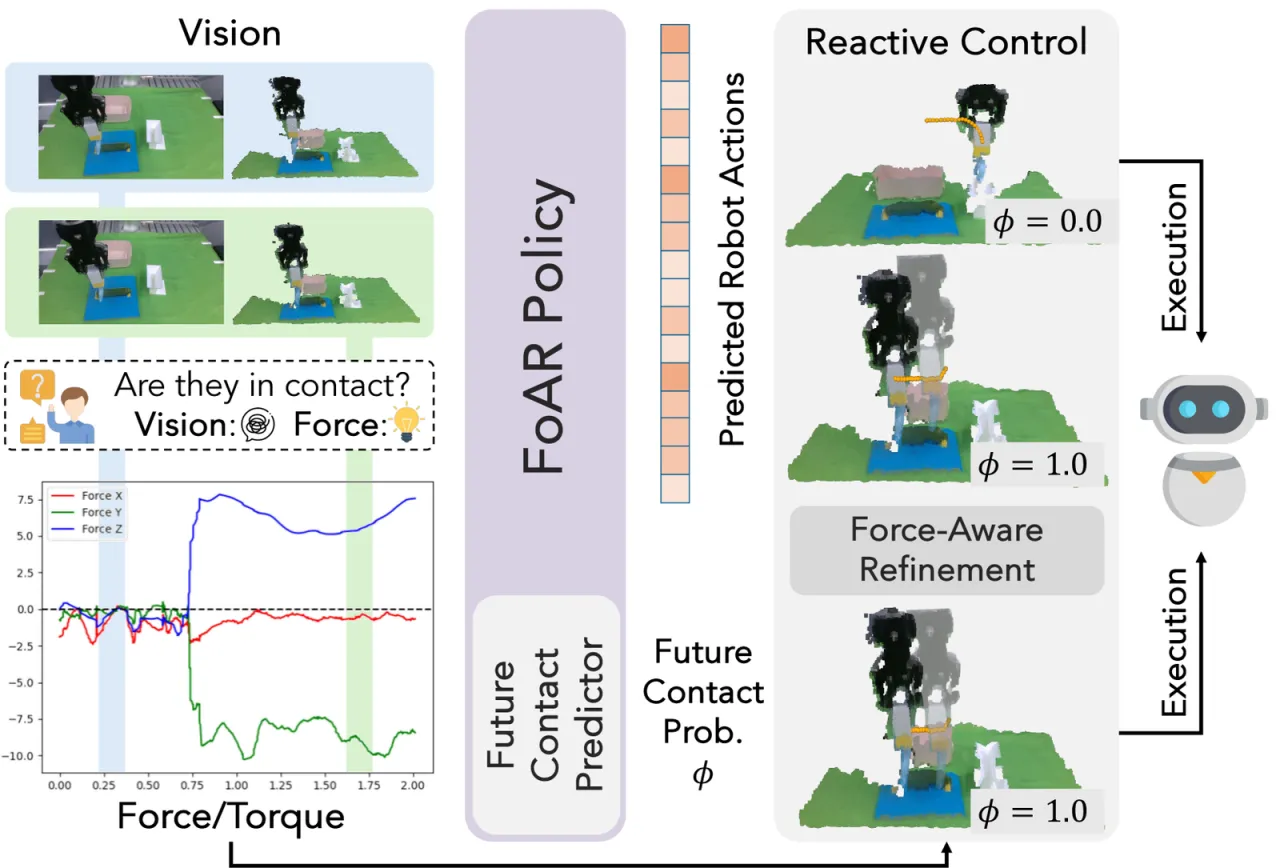
Contact-rich 任务(擦、削、切)对策略提出双重挑战:接触动力学复杂、且需要精确控制。纯视觉策略往往缺少像 force/torque 这样的关键接触反馈模态——单看图像很难判断工具与物体"到底接没接触上",导致要么悬空空扫、要么用力过猛。

"Vision-based policies often struggle with the skill required for such tasks, as they typically lack critical contact feedback modalities like force/torque information."
FoAR overview
Figure 1 · FoAR 概览。上:仅凭 vision 难以区分接触与非接触状态("Are they in contact? Vision 困惑,Force 清晰"),凸显引入 force/torque 的必要性。中:FoAR Policy 由 future contact predictor 输出接触概率 φ,指导多模态融合并预测机器人动作。右:reactive control 在 φ≈1 但力不足时做 force-aware refinement,微调动作后再执行。
0.875Wiping score(RISE 0.500)
100%Peeling 削皮 ASR(RISE 50%)
3.9Chopping 平均切段数(RISE 1.8)
100Hzforce/torque 采样,约 2s 窗口

02 Method

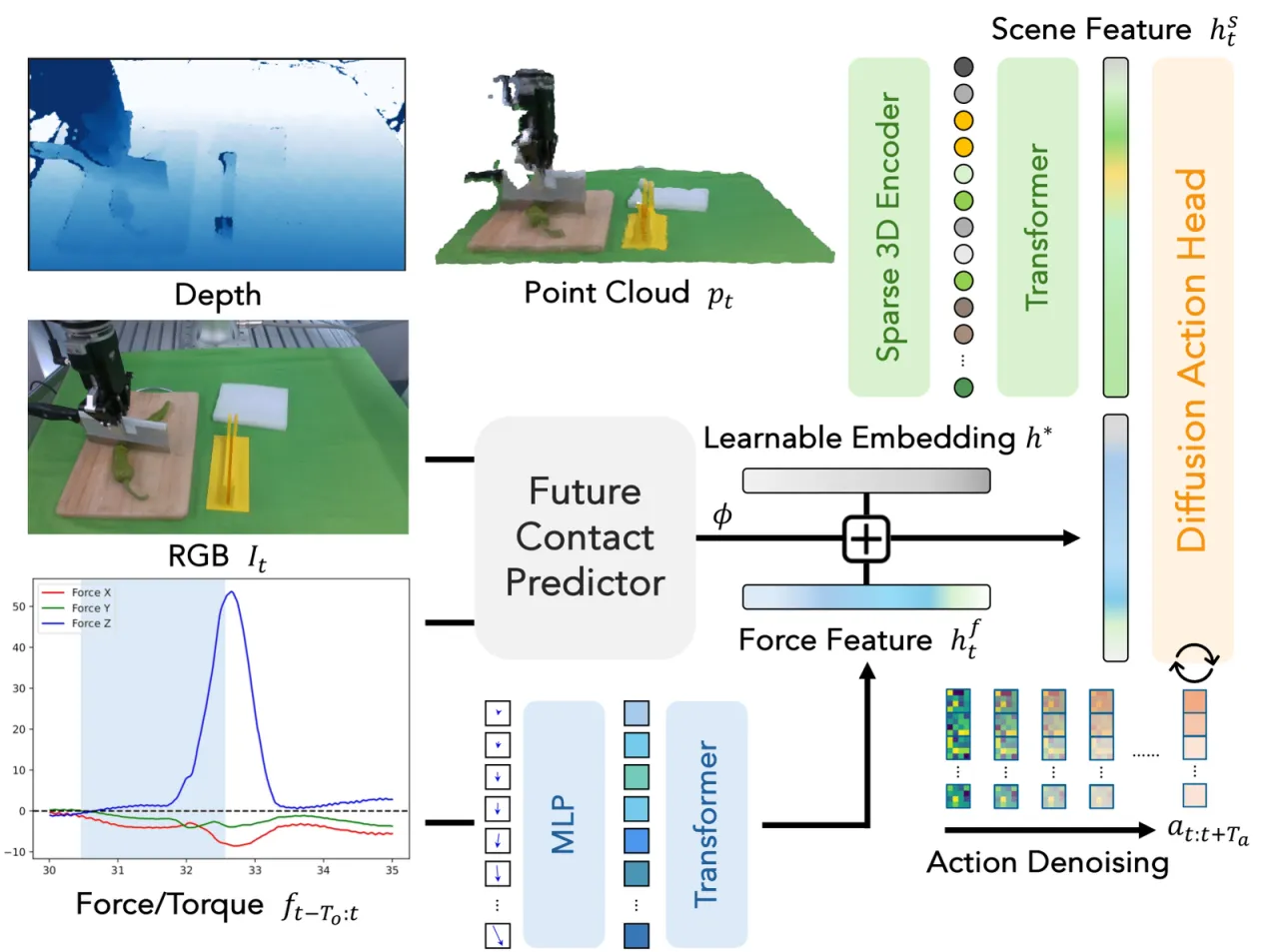
FoAR 建立在 real-world 模仿策略 RISE 之上:point cloud 经 sparse 3D encoder + transformer 得到 scene feature,再由 diffusion action head 输出动作序列。FoAR 在此之上并联一条 force/torque 分支,并用 future contact predictor 把两条模态"按需"融合。

FoAR architecture
Figure 2 · FoAR 架构。上支路:point cloud pt → Sparse 3D Encoder → Transformer → scene feature hts。下支路:force/torque 序列 ft−To:t → MLP → Transformer → force feature htf。future contact predictor(输入 RGB It 与力信号)输出接触概率 φ,用于把 force feature 与 learnable embedding h* 加权融合,再与 scene feature 拼接送入 diffusion action head 做 action denoising。
Force/Torque 编码

采集高频 force/torque 数据(100Hz、约 200 个时间步 ≈ 2 秒),先经 3 层 MLP 得到 512 维 force token,再用带 sinusoidal positional encoding 的 transformer 编码为 force feature htf。相比只在末端拼一个瞬时力向量,这样保留了力信号随时间的变化趋势。

Future Contact Predictor

用 ResNet18 视觉编码器 + MLP 力编码器,输出接触概率 φ ∈ [0,1],表示未来 ±2 秒窗口内发生接触的可能性。它是整个策略"何时相信力信息"的开关。

多模态特征融合(φ 引导)

融合特征把 scene feature 与 [φ × force feature + (1−φ) × learnable neutral embedding h*] 拼接。非接触段 φ→0,力分支被中性 embedding 顶替,避免噪声力信号干扰;接触段 φ→1,力信息被充分使用。由此实现"在非接触段与接触段之间动态调节 force/torque 数据的使用"。

Reactive Control

部署时的反应式修正:当预测接触概率超过阈值(δφ=0.9)但检测到的力/力矩不足(δf=8N、δt=5N·m)时,沿估计方向对预测动作做一个小位移修正(ε=0.006m)。这让 FoAR "仅用简单的 position control" 也能把接触压实到位,而无需显式的力控/阻抗控制器。

03 Experiments

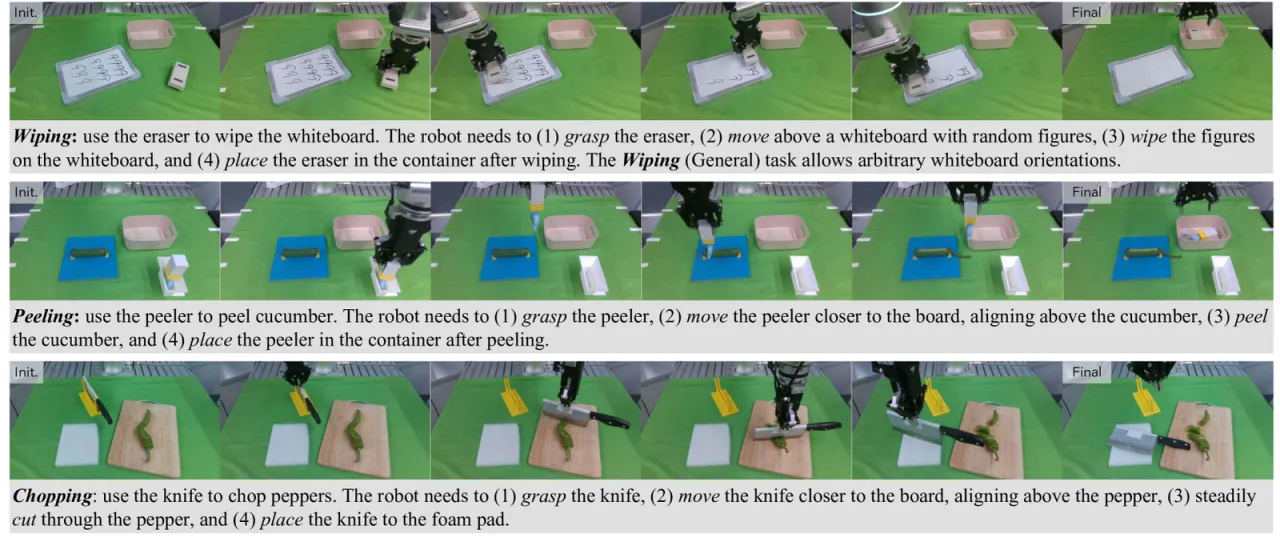
在真实机器人上设计 3 类 contact-rich 任务——Wiping(擦白板,含 General 任意朝向变体)、Peeling(削黄瓜皮)、Chopping(切辣椒),每个任务都包含非接触段与接触段。指标为分阶段平均成功率 ASR(%) 与综合任务 score。Baseline 为 RISE 及其两个融合力信息的变体 RISE (force-token) / RISE (force-concat)。

tasks
Figure 3 · 三个任务的流程分解。每个任务都遵循 grasp → move → 接触操作(wipe / peel / cut)→ place 四步,覆盖非接触与接触阶段以全面评估策略。

Wiping / Peeling(Table I)

MethodWiping scoreWiping (General) scorePeeling scorePeeling ASR
RISE0.5000.5000.37750%
RISE (force-token)0.5750.6000.48775%
RISE (force-concat)0.4750.52480%
FoAR (ours)0.8750.8500.756100%

FoAR 在三项 score 上均大幅领先,Wiping 的 wipe 阶段 ASR 达 100%(RISE 仅 75%),Peeling 的 peel 阶段 ASR 达 100%(RISE 仅 50%)。简单地把力"塞进"RISE(force-token / force-concat)虽有小幅提升,但远不及 φ 引导的动态融合。

Chopping(Table II)

Method# SegmentsNorm. Length Avg.Norm. Length Std.Place ASR
RISE1.8 ± 0.60.7270.41130%
FoAR (ours)3.9 ± 0.90.3530.09470%

切辣椒任务鼓励切成若干均匀小段且不因半切而粘连:FoAR 平均切出 3.9 段(RISE 1.8 段),切段长度更短更均匀(Avg 0.353、Std 0.094,均优于 RISE),说明力反馈帮助刀"切透"。

Ablations(Table III · Wiping General)

MethodScoreWipe ASR
FoAR w/o Reactive Control0.65080%
FoAR w/ Reactive Control0.850100%

去掉 reactive control 后 score 从 0.850 降到 0.650、wipe ASR 从 100% 降到 80%,验证了反应式位置修正的作用。鲁棒性测试中,面对重写、移动白板及组合扰动,FoAR 维持 0.80–0.85 的 score,而 RISE 仅维持 0.50–0.60。

04 Limitations

Note: 原文未设独立的 "Limitations" 章节,仅在结论中给出未来方向。下列第 1 条为作者明确提及的 future work(stated),第 2、3 条为依据方法设计推断(inferred)。
控制策略仍较朴素(stated)

FoAR 目前仅用 simple position control + reactive refinement 完成接触任务。作者指出未来可引入更先进的控制策略,如 compliance control、hybrid force/position control 来处理更复杂的接触。

单臂、任务集有限(stated / inferred)

实验为单臂机械臂上的 3 类任务。作者提出可扩展到 dual-arm 或 humanoid 机器人以完成更复杂任务;当前泛化到全新任务类别的能力未被验证。

依赖 future contact predictor 与人工阈值(inferred)

reactive control 依赖 δφ=0.9、δf=8N、δt=5N·m、ε=0.006m 等手工设定的阈值,且 φ 预测器需要额外训练;这些超参在不同硬件/任务上可能需重新标定。