Wancong Zhang, Basile Terver, Artem Zholus, Soham Chitnis, Harsh Sutaria, Mido Assran, Randall Balestriero, Amir Bar, Adrien Bardes, Yann LeCun, Nicolas Ballas · FAIR at Meta / NYU / Mila / Brown
world modelhierarchical planningmodel predictive controllatent space subgoalmacro-actionzero-shot controlVJEPA2-ACDINO-WM机器人操作长时程规划
01 Motivation
latent world model + MPC 的吸引力在于:只用 reward-free 的离线轨迹按 next-latent prediction 训练,推理时靠 cost-based optimization 就能零样本完成目标导向控制,不需要为任务训策略。但论文指出这套 flat planning 在两种不同的 regime 下都会失败。
"On non-greedy tasks like pick-and-place — where the optimal trajectory must temporarily move away from the goal — the goal-matching cost the planner minimizes is non-monotone along that trajectory, trapping local optimizers in greedy shortcuts even at modest horizons... On long-horizon tasks, prediction errors compound over autoregressive rollouts and the action search space grows exponentially with horizon."
层次化本可以同时缓解这两点,但已有路线都对不上"零样本 + 视觉世界模型"这个设定:hierarchical RL(options / skills / hierarchical policy)需要任务专属奖励或任务分布;hierarchical world model 多数仍绑在 policy learning 上;而最优控制里的 hierarchical MPC 虽然 task-agnostic,却"largely restricted to low-dimensional state spaces, hand-engineered representations, or known dynamics"。
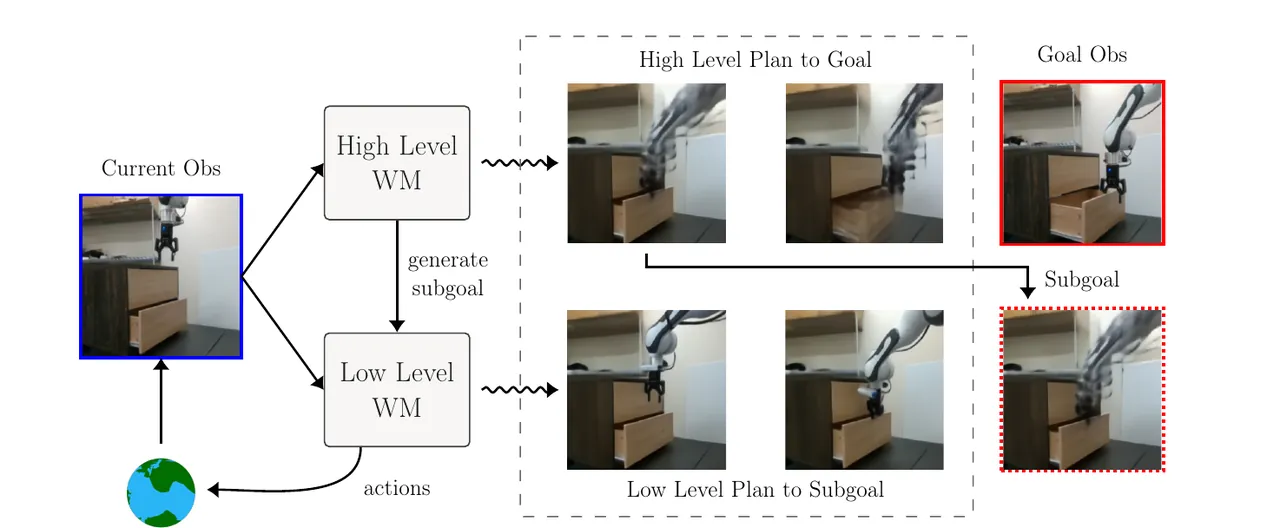
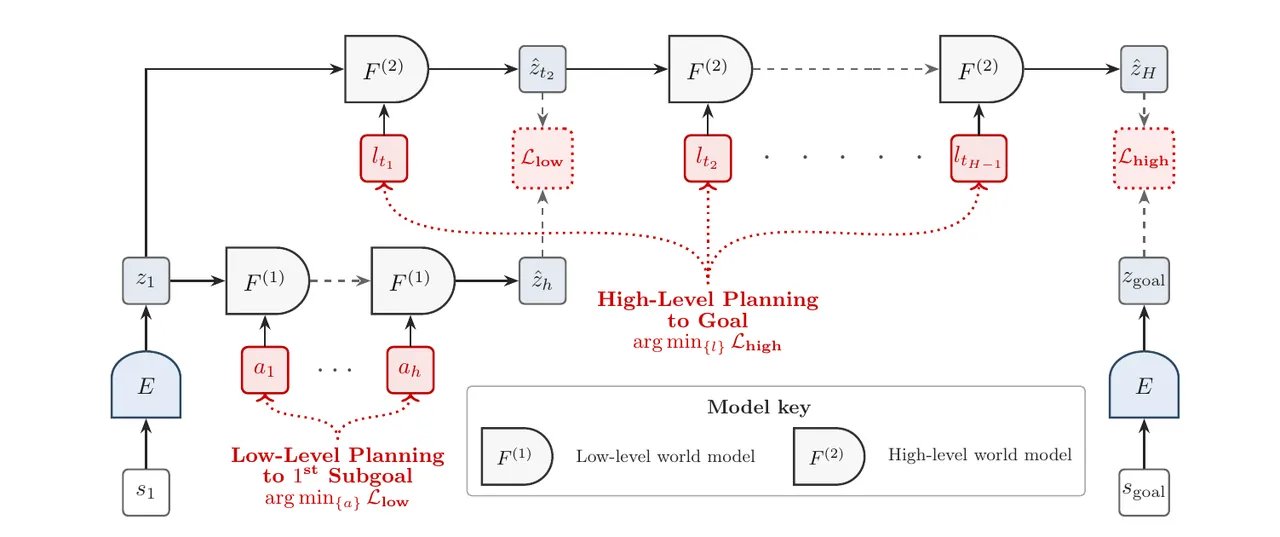
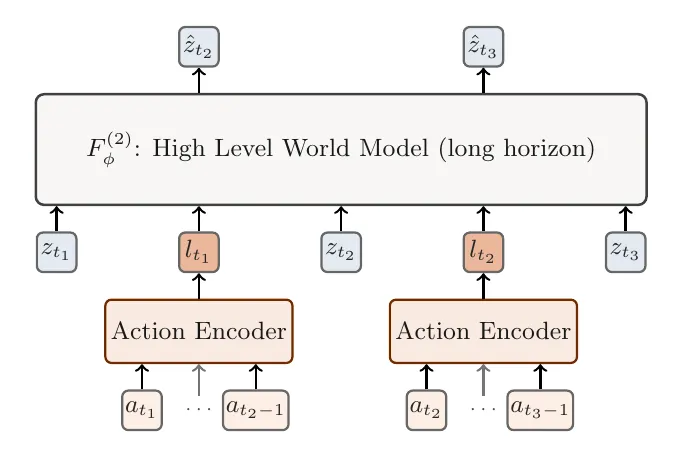
高层若直接在拼接的 primitive action 上搜索,维度会爆炸。HWM 引入一个可学的 action encoder Aψ,把 waypoint 之间的动作块压成紧凑的 macro-action。注意 HWM 不假设固定的高层 horizon h——"allowing each high-level transition to correspond to a variable-length segment of low-level execution"。
Figure 3:高层世界模型用从低层动作块编码出的 macro-actions 捕捉长时程动力学,是 causal 的,用 latent prediction loss 训练。训练时从轨迹里采 N 个 waypoint index,把 waypoint 编成 ztk=E(stk)、动作块编成 ltk=Aψ(atk:tk+1),交错序列 (ltk, ztk) 喂给 F(2)φ 预测下一个 waypoint latent,用 teacher-forcing 的 ℓ1 loss 监督。
这样做带来两个好处(论文原话):其一,"fewer autoregressive rollout steps are needed to reach a given goal horizon, reducing compounding error";其二,"compressing primitive action chunks into a lower-dimensional latent space shrinks the high-level MPC search space, making long-horizon optimization more tractable"。
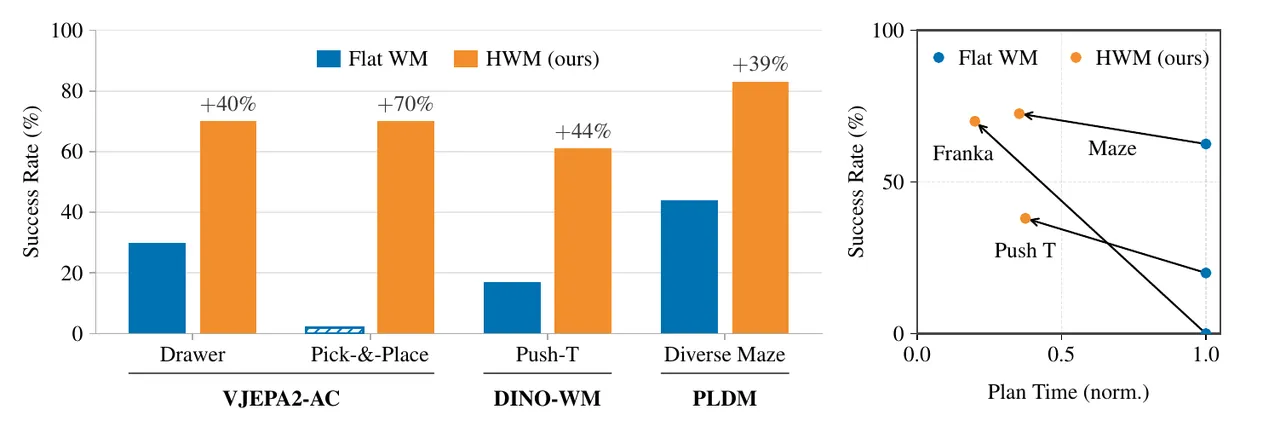
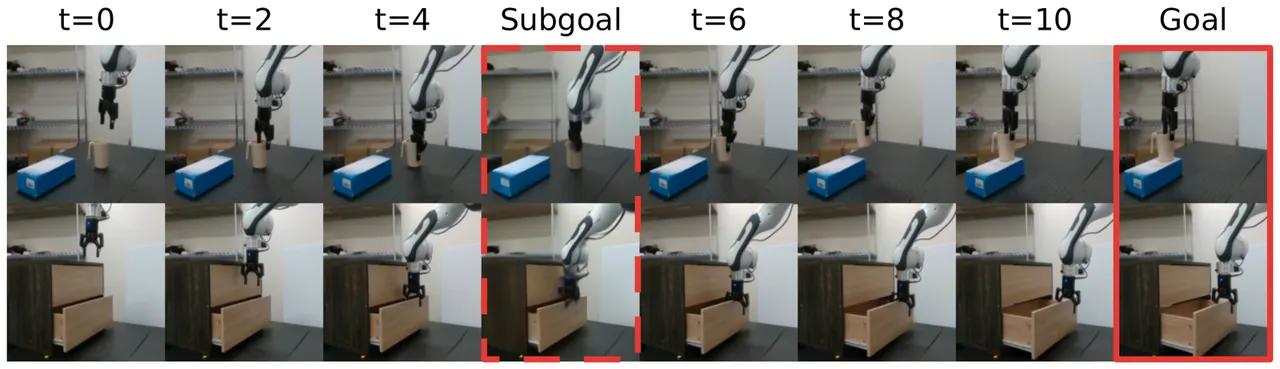
注意口径差异:HWM 与 Octo 用单张 goal image,而 π 系列用语言目标。论文的表述是 HWM "is competitive with these baselines despite significantly less training data (∼77×), and far exceeds Octo under identical image-goal supervision"——在 P&P Cup 上 π0.5-DROID 的 68% 与 HWM 的 70% 基本持平,Box 上 HWM(60%)高于 π0.5(36%)。Drawer 上 flat planner 只解出 2/7 个可以线性推拉的任务。
Maze 最难档上 hierarchy 几乎把成功率翻了一倍(44% → 83%);最易档 D∈[5,8] 两者都是 100%,分层并没有额外收益——这也印证了论文的说法:coarse subgoal planning 主要对长时程有用。另外论文强调,Push-T 的差距"is not explained by parameter count:capacity-matched single-level planners do not match HWM and sometimes degrade with increased capacity"。Maze 上 HWM 以 4× 更少的 compute 取得更高成功率。
结论很干净:有了正确的中间目标,VJEPA2-AC 世界模型完全胜任这些任务(80%/80%),所以 "the failure of single-level planning is hierarchical in nature, not representational"。HWM 在不给任何人工分解的前提下自动恢复了其中大部分性能(70%/60%)——但也确实没有完全追平这个 oracle 上界。
消融 2:macro-action 的参数化方式
High Level Action(Table 5, Maze)
D∈[9,12]
D∈[13,16]
Concat Primitive Actions
52
37
Macro-Action
95
83
High Level Action(Table 6, Franka)
Cos ↑
ℓ1 ↓
Delta Pose
0.80 ± 0.02
0.088 ± 0.005
Macro-Action
0.88 ± 0.03
0.080 ± 0.002
学出来的 macro-action 同时胜过"拼接 primitive actions"和"手工的 end-effector 位移(delta pose)"。对后者论文的解释是:简单的位移摘要会丢掉时间结构,"they can collapse extended, non-greedy trajectories into a single endpoint displacement"。
"Despite these gains, success rates degrade with task horizon for every method we evaluate; closing this gap will require further progress in world modeling and planning." 从表 2/3 也能看出:Push-T d=75 只有 61%,Maze 最难档 83%,离饱和还很远。
各层共用同一个 latent space(stated)
"HWM uses a single latent space across hierarchy levels: while this enables direct subgoal transfer, longer horizons and more open-ended environments may benefit from coarser, level-specific abstractions." 共享 latent 是 subgoal 直接传递的前提,也因此限制了高层做更抽象的表征。
subgoal 质量受 waypoint 采样与推理方式限制(stated)
训练时高层用的是"randomly sampled or fixed-stride waypoints";论文自己指出 skill / subgoal discovery 或 dynamic chunking 可以替换掉这套 waypoint 方案而不改动框架其余部分。推理端,"incorporating feedback from the lower-level planner into high-level subgoal optimization may help compensate for the loss of detail in high-level predictions"——目前高层规划是单向下发的,低层的可执行性没有回流。
真机评测规模有限,失败以感知误差为主(inferred + stated)
每个配置 N=5 次试验,pick-&-place 每种物体共 50 次、drawer 35 次;论文提供了 95% Clopper–Pearson 置信区间(Table 17),但样本量决定了区间不会很窄。作者观察到 "HWM failures arise mainly from perceptual imprecision (e.g., depth errors) or near-miss executions, suggesting that coarse high-level subgoals can lose details needed for precise low-level guidance."