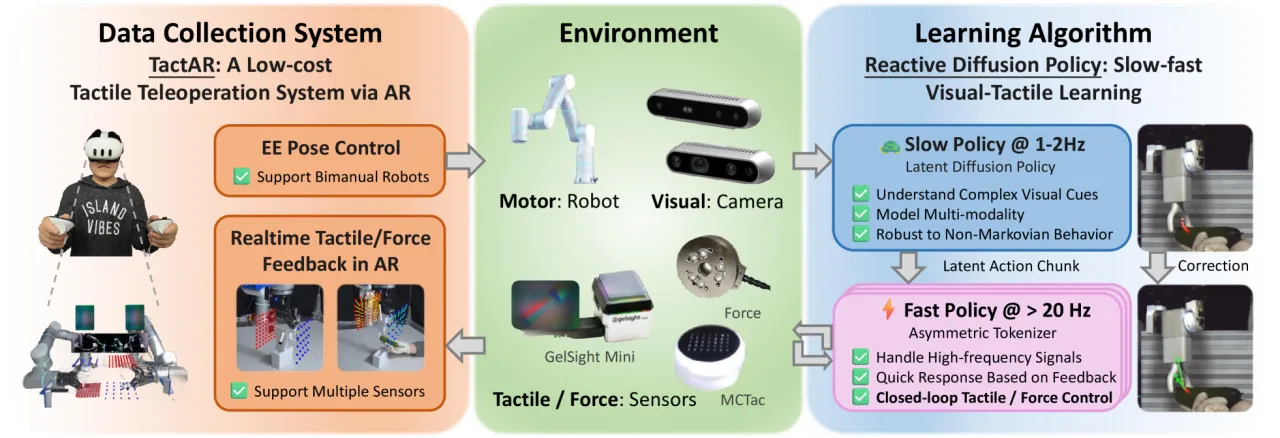
人靠视觉 + 触觉完成接触密集任务,能对外界变化即时反应并自适应控制接触力;而机器人做不到。RDP 用慢-快两级层次把 latent diffusion 的复杂轨迹建模与高频触觉闭环控制统一到一个框架中,并配套一套用 AR 提供实时力反馈的低成本遥操作系统 TactAR。在三项接触密集任务上,RDP 相比 SOTA 视觉模仿学习基线整体得分提升 >35%。
现有视觉模仿学习(visual IL)普遍依赖 action chunking 来建模复杂行为——一次预测一段动作块并开环执行。这带来两个瓶颈:一是在动作块执行期间无法即时响应实时的触觉反馈;二是大多数遥操作系统难以提供细粒度的触觉/力反馈,限制了能采集、能完成的任务范围。
“Existing visual imitation learning approaches rely on action chunking to model complex behaviors, which lacks the ability to respond instantly to real-time tactile feedback during the chunk execution.”
论文的设计灵感来自人类的慢-快双系统:慢系统开环预测粗略动作(伸手去够杯子),快系统再依据触觉反馈做闭环微调(接触后调整抓握力)。RDP 正是要在一个统一框架里同时具备“复杂轨迹建模”与“快速反应”。
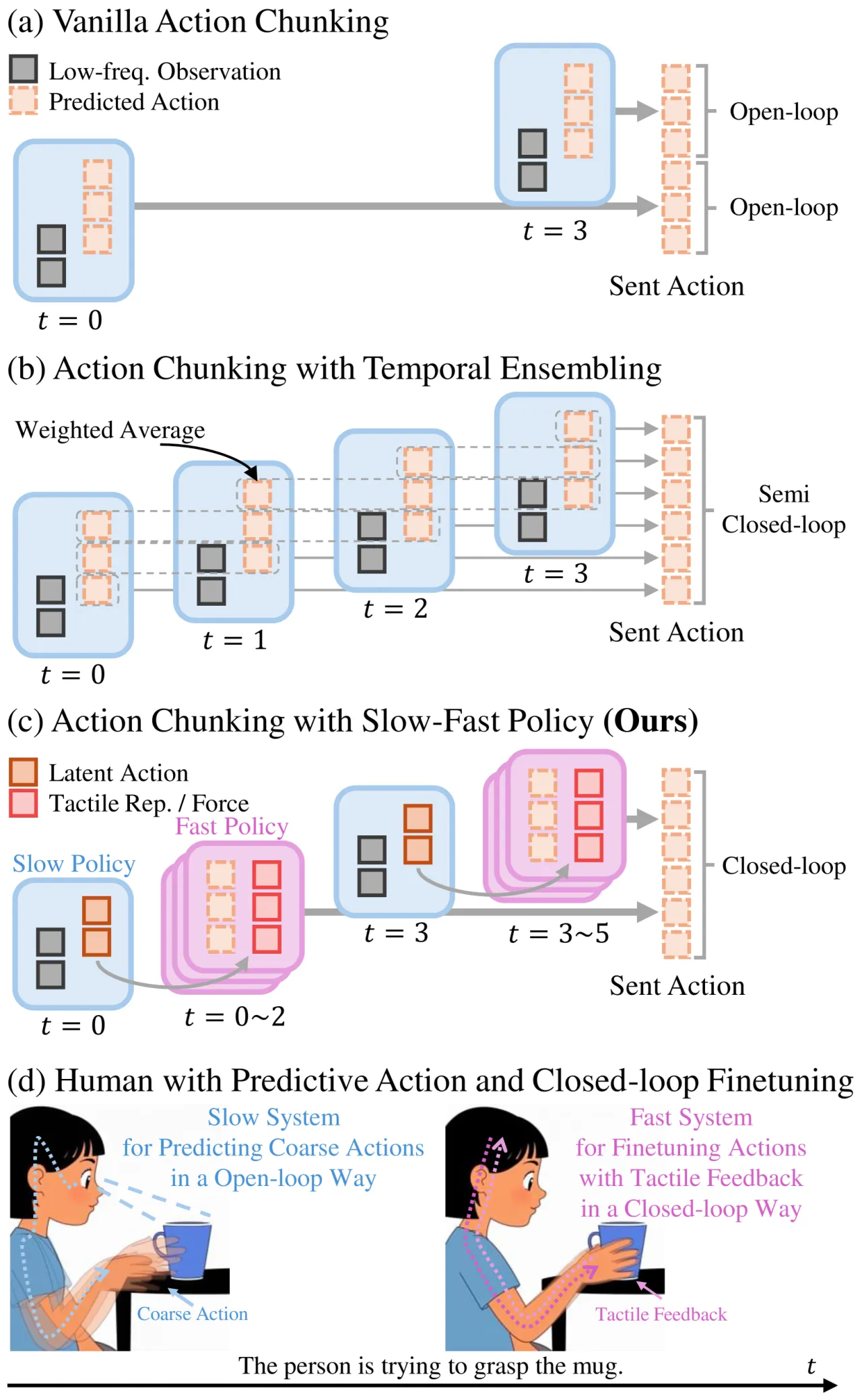
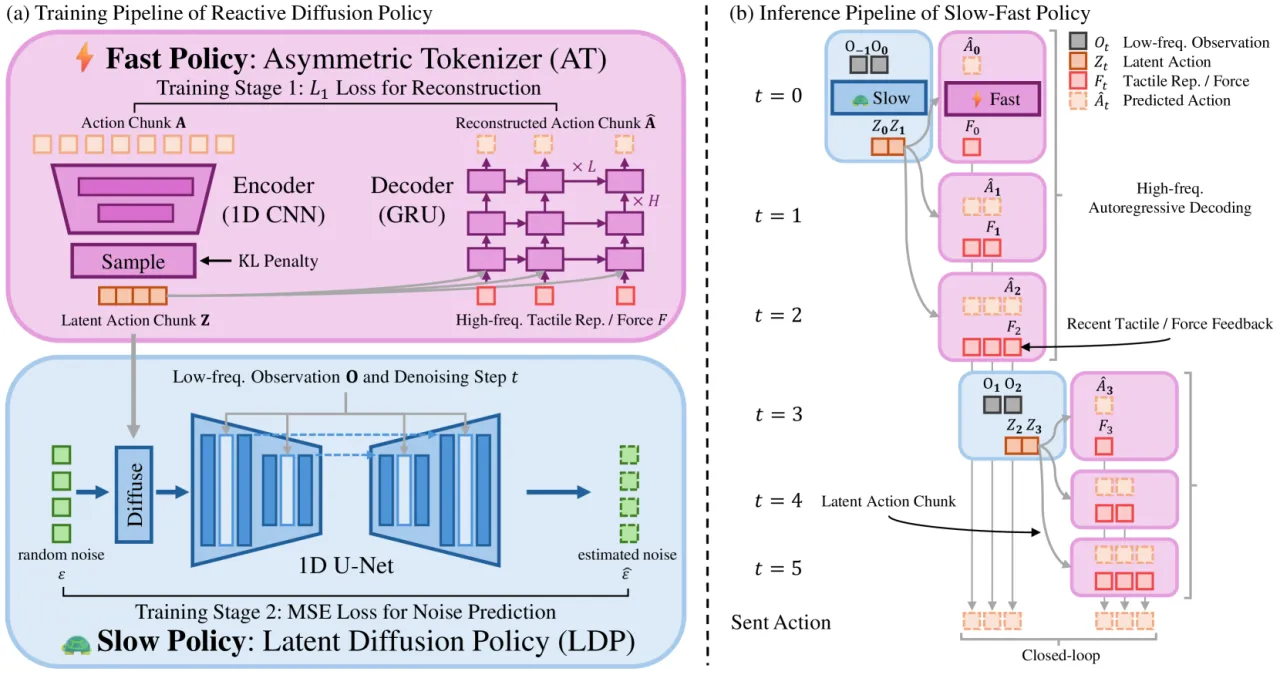
RDP 采用两级层次:(1) 慢策略——low-frequency 的 Latent Diffusion Policy (LDP),在 latent 空间里以低频(1–2 Hz)预测高层动作块;(2) 快策略——high-frequency 的 Asymmetric Tokenizer (AT),以高频(>20 Hz)依据触觉/力反馈做闭环控制。数据侧则由 TactAR 遥操作系统采集:它把触觉信号表示为3D deformation field(一种可跨多种触觉/力传感器通用的表示),并通过 AR “贴附”到机器人末端,让操作者在 3D 空间中感知丰富的接触信息。
把动作块先压缩进 latent 空间,diffusion(1D U-Net)在 latent 空间对随机噪声去噪、条件于低频观测,充当“神经规划器(neural planner)”。在 latent 空间做 diffusion 让它能理解复杂视觉线索、建模多模态、并对非马尔可夫行为更鲁棒,同时把慢策略的推理频率压到 1–2 Hz。
“非对称”体现在编码器与解码器的输入不同:encoder 只看动作块,decoder 在重建时额外接入高频触觉/力反馈 F。推理时它以自回归方式,围绕慢策略预测的 latent action chunk 做亚毫米级(sub-millimeter)的反应式修正——修正量看似微小,却对接触密集任务的整体表现影响显著。单次推理 <1 ms,理论上可支持 >300 Hz。
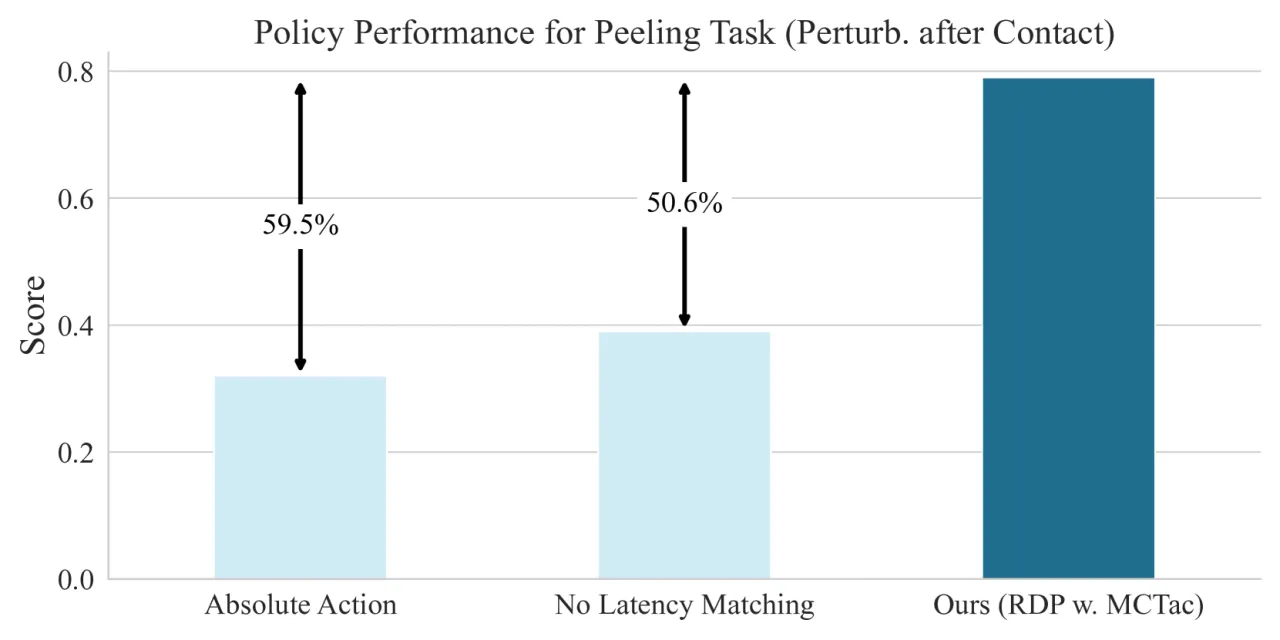
为对齐真机的执行延迟,RDP “discard the first few action steps predicted by the model” —— 丢弃模型预测的前几步,只把与实际延迟精确匹配的动作发给机器人。
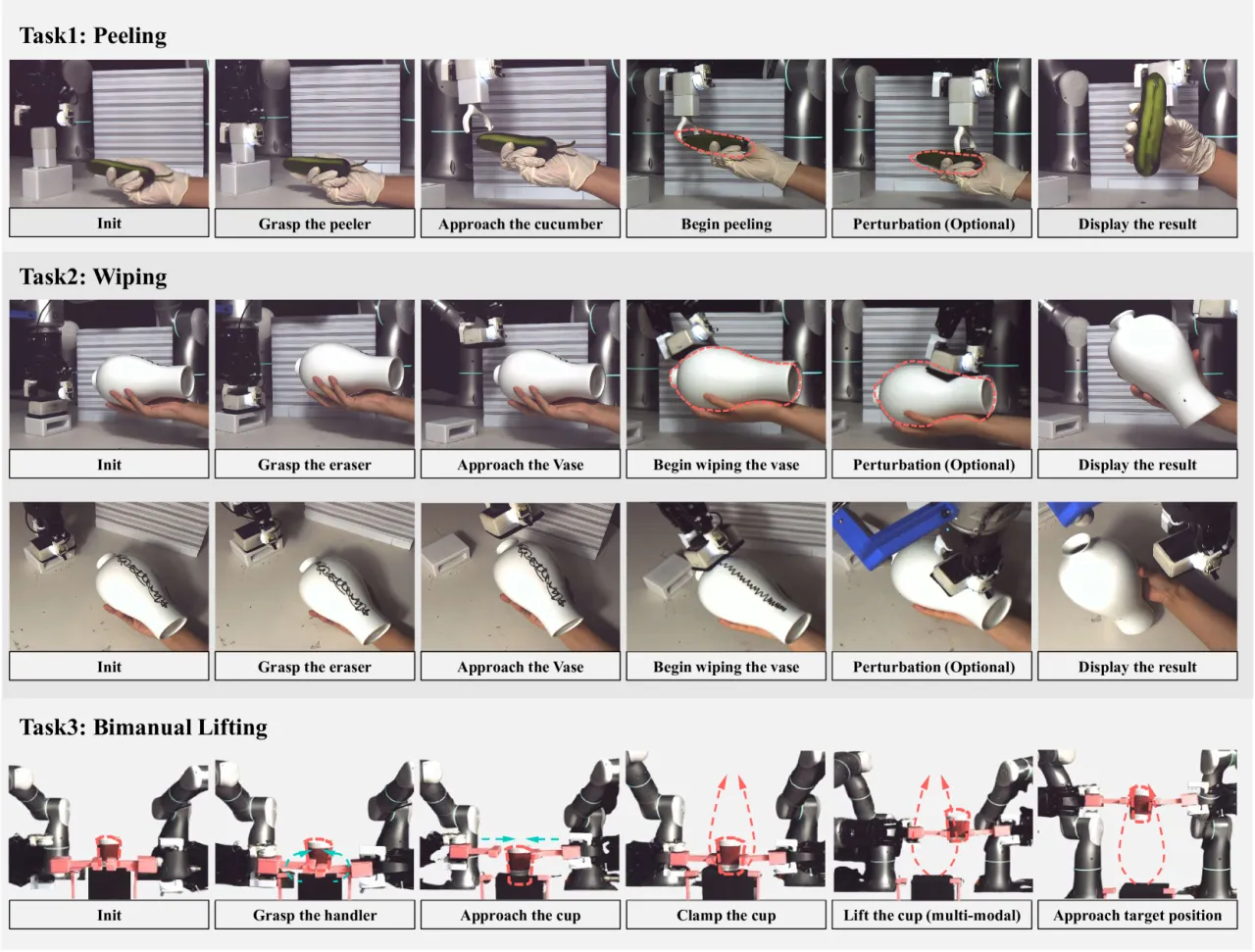
在三项接触密集任务(Peeling 削黄瓜、Wiping 擦花瓶、Bimanual Lifting 双臂夹起纸杯)上评测。基线为 Diffusion Policy (DP) 及其加触觉 embedding 的变体(DP w. tactile emb.);RDP 分别配 GelSight Mini、MCTac、Force 等不同传感器验证通用性。评测含无扰动 / 接触前扰动 / 接触后扰动等条件(得分 0–1)。
| Method | No Perturb. | Perturb. Before | Perturb. After | All |
|---|---|---|---|---|
| DP | 0.56 | 0.58 | 0.19 | 0.44 |
| DP w. tactile emb. | 0.48 | 0.55 | 0.15 | 0.39 |
| RDP (GelSight) | 0.98 | 0.93 | 0.80 | 0.90 |
| RDP (MCTac) | 1.00 | 0.84 | 0.79 | 0.88 |
| RDP (Force) | 0.99 | 0.98 | 0.88 | 0.95 |
| Method | No Perturb. | Perturb. Before | Perturb. After | All |
|---|---|---|---|---|
| DP | 0.75 | 0.70 | 0.25 | 0.57 |
| DP w. tactile emb. | 0.60 | 0.75 | 0.15 | 0.50 |
| RDP (GelSight) | 0.85 | 0.95 | 0.50 | 0.77 |
| RDP (Force) | 0.95 | 0.85 | 0.80 | 0.87 |
| Method | Clamp | Lift | Score |
|---|---|---|---|
| DP | 0% | 0% | 0.00 |
| DP w. tactile emb. | 10% | 10% | 0.08 |
| RDP (GelSight + MCTac) | 100% | 100% | 0.55 |
| RDP (Force) | 100% | 90% | 0.80 |
“As shown in Tab. II, Tab. III and Tab. IV, RDP improves the overall score by a large margin (>35%) compared to various Diffusion Policy baselines.”
差距在接触后扰动(Perturb. After)一栏最为悬殊:基线 DP / DP w. tactile emb. 掉到 0.15–0.25,而 RDP 仍能维持 0.50–0.88——正对应其“动作块执行中仍可闭环反应”的设计目标。RDP 在不同触觉/力传感器(GelSight、MCTac、Force)下都成立,验证了通用性。
另一组消融(TABLE V,Wiping / 接触后扰动)说明:单纯给 DP 缩短 chunk 换取响应速度会崩坏——DP 8 帧块 grasp 成功率 100%、得分 0.15,缩到 2 帧块后 grasp 掉到 20%、得分仅 0.10;temporal ensemble(τ=0.2)grasp 30%、得分 0.05。RDP 则 grasp 100%、得分 0.50。论文指出 temporal ensemble 的表现对平滑系数“very sensitive”,难以实用。
“The fast policy in the RDP algorithm is currently limited to responding to high-frequency tactile / force input signals but cannot swiftly process high-frequency image inputs.” —— 高频视觉闭环仍是未解问题。
“TactAR system is designed for two-finger grippers.” 作者把扩展到灵巧手(dexterous hands)列为有前景的方向。
作者指出人通过该系统的遥操作 “not as intuitive or efficient as direct human-hand operations”。